
🏦Perplexity Plugs Its AI Agent Into Bank Accounts
Perplexity rolled out a new Plaid integration that lets users connect bank accounts, credit cards, and loans directly to its Computer agent, turning it into a full personal finance hub.
- —Plaid's 12K+ bank network feeds into Computer, with users able to pull in checking, credit, loan, and brokerage data for a read-only view of their money
- —The agentic system can build customized tools like budgets, net worth trackers, debt payoff plans, and retirement dashboards via simple text prompts
- —The move comes on the heels of Perplexity's U.S. tax integration that autonomously fills out IRS forms and reviews professional-prepared returns
- —Perplexity Computer launched in late February, with the agentic pivot pushing Perplexity's ARR past $450M in March, a 50% jump in a single month
Why it matters: Perplexity built its name trying to out-Google Google, but Computer has completely changed the trajectory. With smart connectors and a powerful AI agent, the company is suddenly competing with Mint, TurboTax, and every other app area it integrates — not just search.

✍️ Jassy's $200B Amazon AI Spend Now Has Receipts
Amazon CEO Andy Jassy shared his annual shareholder letter with the company's first-ever AI revenue figures and a defense of the $200B planned capex, dismissing bubble talk and floating the idea of selling Trainium chips to outside buyers.
- —AWS's AI arm crossed $15B in annualized revenue, a number Amazon had never disclosed — and 260x where AWS itself stood at the same point
- —The custom Trainium, Graviton, and Nitro chips crossed $20B in yearly revenue, and Amazon may sell racks of them to third parties in the future
- —Two unnamed AWS customers asked to buy the company's entire Graviton chip supply for 2026, with Amazon declining to protect other clients' access
- —Amazon's $200B AI spending rattled investors, with Jassy's letter firing back with first-ever revenue figures and locked-in customer demand
Why it matters: If you only tracked models as a barometer for the AI race, Amazon might look like it's behind — but the $20B chip numbers tell a different story. Nvidia has dominated AI compute, but the supply side of the boom is finally getting real competition at exactly the moment demand has never been higher.
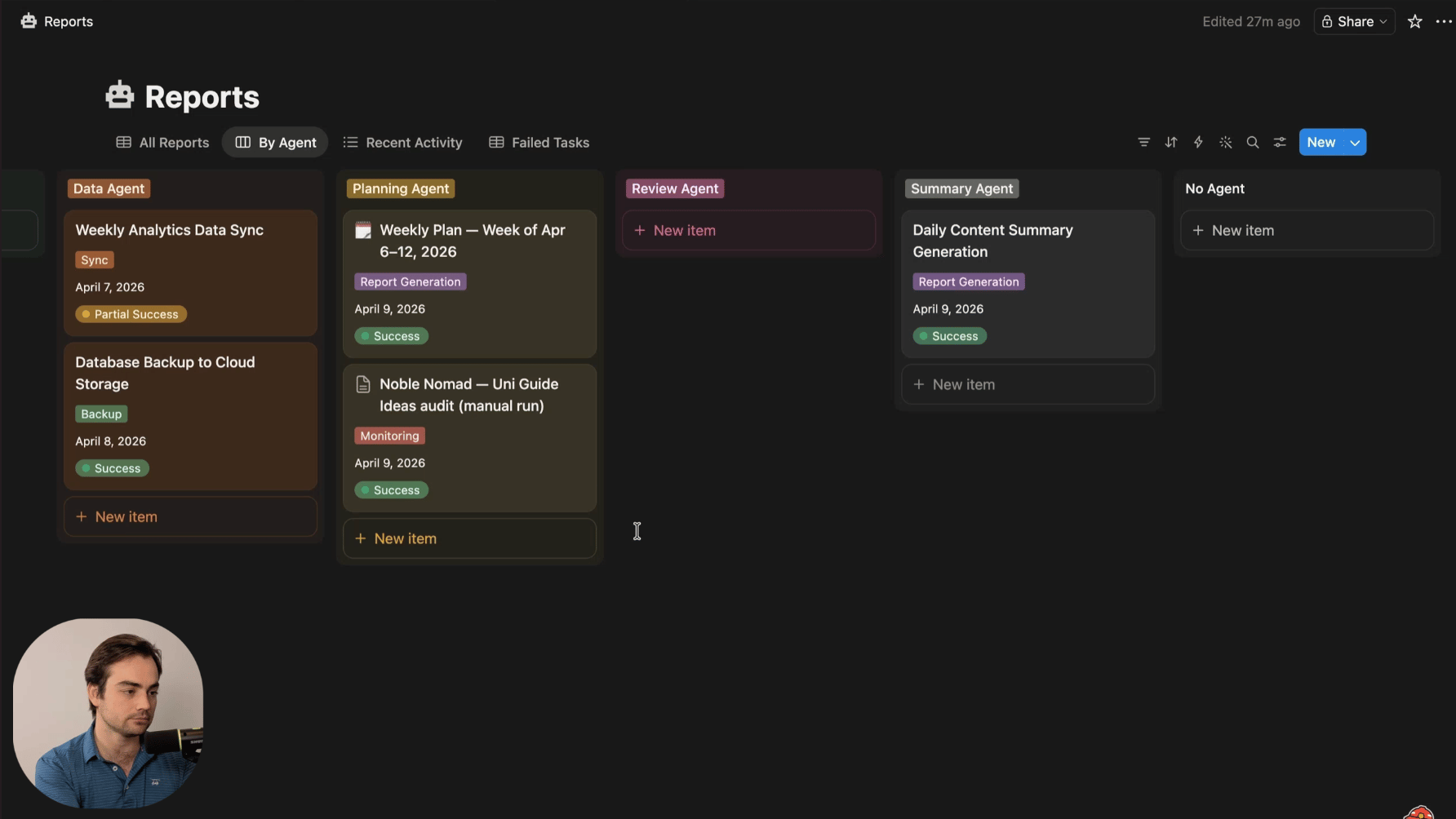
⚙️ Automate Your Business With Custom Notion Agents
This guide shows how to build Notion Custom Agents that run your company's recurring work on a schedule, automating inbound leads, campaigns, accounting, or any recurring job without adding complexity.
- —In Notion, create two databases — Tasks (Name, Source, Priority, Status, Assigned To) for every to-do, and Reports for agents to log their work
- —Open Notion AI, click Create custom agent, and prompt it to define functionality like reading weekly emails, adding action items, and writing summaries
- —Notion drafts the agent with a name, trigger, instructions, and data sources — connect Gmail, confirm the schedule, and save
- —Clone the same pattern for every recurring job: same two databases, different agent, with every run traceable in one place
Why it matters: Notion Custom Agents let non-technical users build automated workflows, shifting repetitive tasks from manual effort to AI-driven scheduled execution and dramatically reducing operational complexity.

🫀Oxford AI Catches Heart Failure Five Years Early
Researchers at the University of Oxford introduced an AI system that picks up invisible changes in heart fat from routine CT scans, flagging patients at high risk of heart failure up to five years out — with 86% accuracy across 72K patients.
- —Fat around the heart shifts texture when the muscle beneath is inflamed, with the AI reading patterns invisible to doctors on any current scan
- —In the highest-risk bucket, 1 in 4 patients ended up with heart failure within five years — a 20x gap versus those the AI flagged as safe
- —Oxford is already working with regulators to bring the tool to NHS hospitals, and plans to extend it to all chest CT scans within months
Why it matters: Heart failure's biggest problem isn't treatment, it's timing. Doctors usually can't act until damage has set in, so an 86%-accurate early warning system built into scans patients are already getting could shift the equation from reaction to prevention for better diagnosis and outcomes.